Music Academy Dance Festival 2027: Full Schedule Guide
📋 On this page +
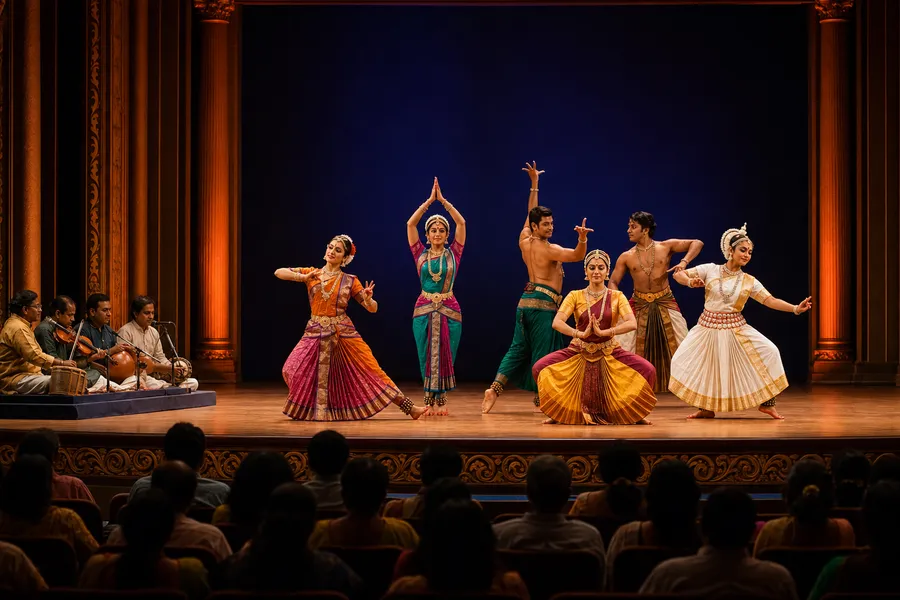
The Music Academy’s 20th Annual Dance Festival will run from Sunday, 3 January, to Saturday, 9 January 2027. The seven-day program features Bharatanatyam, Odissi, Kuchipudi, Mohiniyattam and Kathakali through solo, duo and group performances.
From 4 to 9 January, the daily structure includes three non-ticketed daytime recitals at 9:30 AM, 11:00 AM and 12:30 PM, followed by ticketed evening performances at 6:00 PM and 7:45 PM. One evening ticket is valid for both ticketed recitals that day.
The opening day is different: it begins directly with two ticketed evening performances.
Music Academy Dance Festival Details
| Detail | Information |
|---|---|
| Dates | 3 to 9 January 2027 |
| Venue | The Music Academy, 168 TTK Road |
| Free recitals | 9:30 AM, 11:00 AM and 12:30 PM from 4 to 9 January |
| Ticketed recitals | 6:00 PM and 7:45 PM |
| Ticket rule | One evening ticket covers both evening recitals |
| Full program | Official 20th Annual Dance Festival schedule |
Artist order and timings should always be rechecked on the official page before travel.
What Makes The 20th Festival Significant?
The Dance Festival extends Chennai’s December and January season beyond music into a concentrated week of classical dance. Its 20th edition shows that the program has developed its own continuity, audiences and artistic expectations.
The schedule balances senior, awarded and institutionally recognized artists with daytime performers who may be earlier in their careers. It also places several Indian classical forms beside Bharatanatyam, encouraging audiences to see difference rather than treat classical dance as one visual language.
The festival’s value is not only the number of performances. Multiple daily recitals allow students and rasikas to compare approaches to rhythm, abhinaya, repertoire, group composition, music and stagecraft.
How Does Each Day Work?
The opening evening on 3 January features:
- 6:00 PM: Nritya Kalanidhi Urmila Sathyanarayanan, Bharatanatyam
- 7:45 PM: Kalakshetra Foundation, Bharatanatyam group
From 4 through 9 January, the regular structure is:
- 9:30 AM to 10:45 AM: Non-ticketed recital
- 11:00 AM to 12:15 PM: Non-ticketed recital
- 12:30 PM to 1:45 PM: Non-ticketed recital
- 6:00 PM to 7:30 PM: Ticketed recital
- 7:45 PM to 9:15 PM: Ticketed recital
The afternoon gap gives visitors time to eat, rest and return. Do not assume a seat or entry arrangement carries from the free program to the evening ticketed program.
Which Performances Are Free?
The three daytime recitals from 4 to 9 January are non-ticketed. These slots include a substantial list of Bharatanatyam performers such as Bhavya Ramachandran, Christopher Gurusamy, Aishwarya Balasubramanian, Lekha Prasad, Pritam Das, Shweta Prachande, Medha Hari and others.
Free access is a chance to discover artists and compare individual choices. It is not a signal that the work is less serious. Arrive before the listed start, sit without reserving excessive seats and remain for the complete recital where possible.
Students can build a full morning around three different performers at no ticket cost. The real investment is attention.
How Do Evening Tickets Work?
Both evening recitals are ticketed, and the Academy says one ticket is valid for the 6:00 PM and 7:45 PM performances on that date.
Its ticket FAQ says season ticket sales continue online until 10 December and daily tickets begin two days before each performance. After purchase, check spam for the email. The QR code can be exchanged for a physical ticket during working hours.
Choose a date after reading both evening listings. The combined ticket is best understood as a curated pair, not one desired performance plus an unwanted extra.
Buy through the Academy’s official route and avoid screenshots or unofficial transfers.
What Dance Forms Are Included?
Bharatanatyam
Bharatanatyam is the most represented form, across solo, duo and group programs. Do not expect one uniform style. Training lineages, repertoire, musical teams, physical approach and abhinaya can differ significantly.
Odissi
Ratikant Mohapatra presents an Odissi group on 4 January, and Nrityagram closes the festival with an Odissi group on 9 January. Watching two group approaches on different days can reveal how sculptural line, torso movement, rhythm and ensemble design are handled.
Kuchipudi
Shivamohanam, Mosalikanti’s School of Kuchipudi, appears as a group on 5 January. Look for how dramatic movement, rhythmic precision and group structure distinguish the program.
Mohiniyattam
Nritya Kalanidhi Dr Neena Prasad presents Mohiniyattam on 7 January. The form’s movement quality and relationship to music provide an important contrast within the week.
Kathakali
P. S. V. Natyasangham presents a Kathakali group on 8 January. Read any program note available because narrative, character and gesture become richer with context.
Which Evening Should You Choose?
Choose based on a pairing rather than one famous name.
The opening offers Urmila Sathyanarayanan followed by Kalakshetra Foundation. Other evenings pair solo Bharatanatyam with group Odissi or Kuchipudi, present senior Bharatanatyam artists with group work, or combine different forms.
For a first-time dance visitor, a mixed-form evening can make difference immediately visible. For a Bharatanatyam student, an evening pairing solo and group work can be educational. For an experienced rasika, repertory and artist interest may decide.
Check the official schedule for the full daily program and any change.
How Should First-Time Audiences Watch Classical Dance?
Begin with what the stage directs you to notice. You do not need to decode every mudra or identify every tala.
Watch:
- How stillness prepares movement
- Where the dancer looks
- How rhythm travels through feet and torso
- When facial expression carries a lyric
- How music and movement answer each other
- How group spacing creates pattern and meaning
Read a short synopsis if provided. During narrative work, follow character shifts through body and gaze. During abstract dance, notice phrasing and resolution.
Avoid whispering a continuous explanation to a companion. Discuss after the item.
How Can Dance Students Use The Festival?
Set one observation theme per recital. You might track araimandi and line, transitions, stage use, jathi clarity, abhinaya or the relationship with musicians.
Write notes after the performance. Filming is not a substitute for watching and may be prohibited. Do not copy choreography from unauthorized recordings.
Attend forms outside your training. Ask how their movement logic differs rather than judging them against Bharatanatyam criteria.
Notice introductions, bows, costume management and musician acknowledgment. Professional practice includes everything around the item.
How Do You Reach The Music Academy?
The venue is at New No. 168, TTK Road, Chennai 600014.
Metro
Teynampet on the Blue Line is a practical station, followed by an auto-rickshaw, cab or walk based on weather and mobility.
Bus
MTC services connect the surrounding TTK Road, Royapettah, Alwarpet and Mylapore areas. Use live route information and our Chennai bus routes guide for transfers.
Cab Or Auto
Use the complete address and allow evening traffic time. At 9:15 PM, request pickup from a lit, authorized point without blocking the exit.
Car
Parking availability depends on festival operations and demand. Do not assume a space for popular evenings. Public transport can be simpler.
When Should You Arrive?
For free daytime recitals, arrive 25 to 40 minutes early. For ticketed evenings, reach by 5:15 PM for the 6:00 PM start.
The 15-minute gap between evening recitals is short. Use facilities before 6:00 PM and remain mindful of staff preparing for the next artist.
Late entry may be held until a break. Follow ushers and do not cross rows during a quiet abhinaya passage if you can wait.
What Should You Wear And Carry?
Traditional clothing is common but not compulsory. Wear something comfortable for a long seated program and cool auditorium.
Bring:
- Ticket or QR code
- Notebook and pen
- Charged phone and compact power bank
- Light layer
- Essential medication
- Small permitted water bottle
Avoid large bags, noisy jewellery and anything that distracts the artist or adjacent audience.
What Is Good Dance-Festival Etiquette?
Silence the phone and keep the screen dark. Do not use flash or record without permission. A raised device blocks the very lines another viewer came to see.
Applaud at clear completion points. Avoid entering or exiting during an item. Keep comments for the interval.
Do not treat costume, body type or age as gossip. Discuss artistic choices with specificity and respect.
If you meet an artist after the show, allow them to recover and greet others. A brief, sincere comment is better than an unsolicited critique.
Can Children Attend?
Check ticket terms for any age restriction. Older children learning dance can benefit from the non-ticketed daytime slots because a 75-minute recital is easier than a full evening.
Explain quiet-hall behaviour and choose an aisle if a break may be needed. Do not provide noisy snacks. If a child is distressed, step out at the first appropriate moment.
Use volume protection if amplification is uncomfortable, though auditorium dance programs are usually less intense than outdoor concerts.
How Do You Plan Food And Rest?
The gap after 1:45 PM is long enough for lunch and rest before 6:00 PM. Use it. Five performances in one day demand mental and physical energy.
TTK Road, Alwarpet, Royapettah and Mylapore have many food options. Choose somewhere that allows a timely return. December and January season traffic makes short distances unpredictable.
Confirm re-entry and ticket collection before leaving the premises.
What Should Outstation Visitors Plan?
Stay near a useful transit corridor and group other sabha visits by neighbourhood. Do not schedule an afternoon performance across the city and expect to return calmly by 6:00 PM.
Keep one flexible evening in case an artist or schedule changes. Carry both digital and offline ticket information.
If you want city context between events, our Chennai history guide offers a wider introduction to the institutions and neighbourhoods around the season.
How Can You Compare Different Dance Forms Fairly?
Begin by asking what each form values in posture, weight, rhythm, space, music and storytelling. Do not treat one form’s line or movement quality as the universal standard.
Read the program note and observe how the performance establishes its own grammar. In Odissi, Bharatanatyam, Kuchipudi, Mohiniyattam and Kathakali, similar mythic material can be embodied through different conventions.
Afterward, describe one concrete difference without ranking it. This practice helps students and general audiences move beyond costume-based comparison. It also makes the mixed-form programming more meaningful than a sequence of visually attractive items.
If a form is unfamiliar, attend the complete presentation before deciding whether it connects with you. Context often accumulates slowly.
Is The 20th Dance Festival Worth Attending?
Yes. The program offers unusual depth within one week, with free daytime discovery and evening pairings across artists and forms.
Its main risk is fatigue. Watching every recital without rest can reduce attention. Popular evenings may sell out, and parking on TTK Road is not something to leave until 5:50 PM.
Our honest verdict: choose at least one free daytime sequence and one mixed-form evening. Watch unfamiliar artists with the same seriousness as established names.
Frequently Asked Questions
When Is The Music Academy Dance Festival 2027?
It runs from 3 to 9 January 2027.
Which Recitals Are Free?
From 4 to 9 January, the 9:30 AM, 11:00 AM and 12:30 PM recitals are non-ticketed.
Which Performances Need Tickets?
The 6:00 PM and 7:45 PM recitals are ticketed. One evening ticket covers both performances that day.
What Happens On 3 January?
The opening day begins with ticketed evening performances at 6:00 PM and 7:45 PM. There are no listed daytime recitals that day.
Which Dance Forms Are Included?
Bharatanatyam, Odissi, Kuchipudi, Mohiniyattam and Kathakali appear across solo, duo and group programs.
What Is The Nearest Metro Station?
Teynampet is a practical Blue Line station, followed by a short last-mile ride.
Is Parking Guaranteed?
No. Parking depends on venue operations and demand. Use public transport for popular evenings when possible.
Where Can I See More Chennai Cultural Events?
Browse the Chennai events calendar for verified music, dance and arts programs.
Last fact-check: 16 July 2026. Artist order, tickets and entry rules can change. Follow The Music Academy’s official festival page.
Event Locations